
Another great post by The Big Map Blog recently shows a map of Los Angeles’ 1906 railway systems. Those systems weren’t lacking in Echo Park, so we’ve zoomed in on the BIG map to show you a little bit of our ‘hood back in the day.
The Glendale Line, which you can see in green, is a” Los Angeles Inter-Urban RY Co.” line that took people between Glendale and Downtown, and possibly even up to Burbank. The Glendale Line ceased to run in June of 1955. The path made by the Glendale line went past Echo Park Lake on the west side of the lake, through “Edendale” and then they had to cut through the hills creating what was known as the “Edendale Cut” (where the 2 freeway is now) and next to Max Sennett’s studio.
The black lines, which you can see going along Sunset Boulevard then up Echo Park Avenue, were the “Los Angeles Pacific R.R.” There’s an old Three Stooges episode of note that shows Echo Park Avenue and the old railway tracks on the road, and you’ll note a lot of existing stairways in this area so that people could easily access the trains from their hilltop homes.
The red lines note the path for the “Pacific Electric Railway Co.” lines, which on the east side of the Los Angeles River took passengers up to Highland Park and beyond to Pasadena.
And finally, yellow – the “Los Angeles RY. Co.” lines, which had a lot of lines into East Los Angeles and up into what is now Elysian Valley.
However, apart from probably different sized trains between each line, I’m not certain on what the exact difference was between each company that handled the different lines. LA Taco has a little more insight on the matter:
At that point, LA was an underdeveloped but rapidly growing city, and rail was the dominant form of intra-city transportation. The yellow and red lines on the map show the two main competing streetcar systems, Los Angeles Railway (Yellow Cars) and Pacific Electric Railways (Red Cars). At this point, both systems were only 5 years old. The Yellow Cars carried more daily riders, but the Red Cars extended farther from the downtown hub. At the height of the Yellow Car’s operations, the system had 20 streetcar lines and 1,250 trolleys, and served the core of LA in addition to Echo Park, Westlake, Hancock Park, Exposition Park, West Adams, the Crenshaw district, Vernon, Boyle Heights and Lincoln Heights.
Either way, it’s disappointing that in the mid-50s and into the 1960s and ’70s these tracks were being dismantled. Surely there were politics, power and money involved, but you also can’t help but think about the emerging car culture in those times. People were probably more keen on that new Mustang than getting on a dusty old red car!
Click here to download the full map or visit the Big Map Blog website.
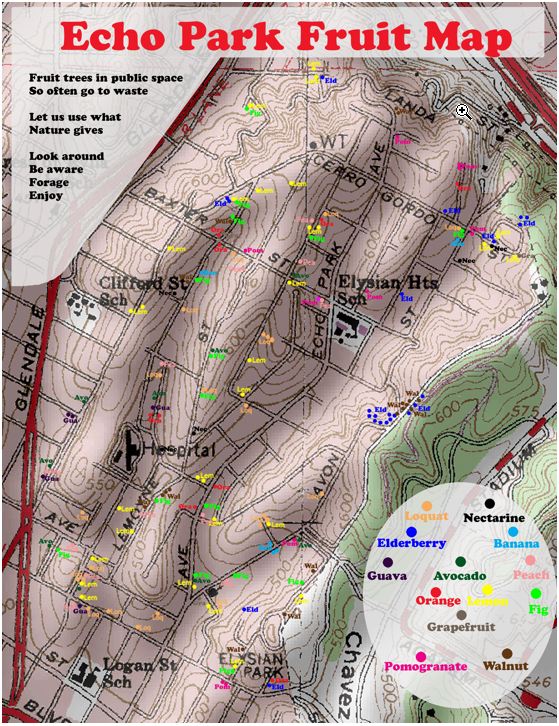
This is a really cute commercial/advertisement featuring the Fallen Fruit guys on their search for public fruit in Echo Park. Though not all of the shots are Echo Park itself, you can see them building the map of Fallen Fruit in Echo Park using social media and other technologies, specifically this “Samsung Galaxy Tab” device and what looks to be similar to the iPad.
While we haven’t find the Echo Park map on the Echo Park map on the Fallen Fruit website yet, we’re sure it will pop up soon. Based on an old map it had a while back (click here to view that map) we started a while back creating a map of our own. Some items may be outdated, and we are slowly building more of the map, but that’s why you’re going to let us know if we’ve missed anything using the comments field below.
View Echo Park Fallen Fruit Trees in a larger map

Photographer Eric Fischer was inspired by a Chicago map created by Bill Rankin that displayed the city’s racial and ethnic divides. He created maps of other cities like New York City, Houston, and Los Angeles using the same techniques Rankin did, applying date from the 2000 census. I took the Los Angeles map and zoomed in on the Echo Park area. Red is White, Blue is Black, Green is Asian, Orange is Hispanic, Gray is Other, and each dot equals a total of 25 people. For some perspective, the little empty round area near the middle of the above graphic is Dodger Stadium.
You can check out the rest of the Los Angeles map by clicking here or on the image below. You’ll notice… there are a lot of white people on the west side!
You may or may not know that when you upload your photo(s) on Flickr, you can “geo-tag” them, providing a location for each photograph. Photographer Eric Fischer has taken the geo-tagged information and turned it into maps that indicate tourists that have posted photos (the red lines and dots) versus the locals (the blue lines and dots). The resident photos are determined by those who posted photos in the city “dated over a range of a month or more,” while the tourists are “people who seem to be a local of a different city and who took pictures in this city for less than a month.” The yellow dots and lines are those who can be either tourist or a resident, and it couldn’t be determined which was which.
The map above shows a zoomed-in view of the “Los Angeles and Pasadena” map. Quite a few tourist shots going on there! Click on the map to view the full map and more of Eric Fisher’s geo-tag maps for other parts of Los Angeles.
Also – shoutout to LAist for its article today on the maps!
“Are you an avid cyclist or looking to ride your bike more often?” Google Maps took a step in a more bike-friendly direction about a month ago when they added biking directions as a transportation option. One can both get directions for traveling via bike and view which streets are safest for cycling. The project is still in the beta phase, however, and the directions and the suggestions for the best biking streets are not definitive.
But, as you can see from the map above, Los Angeles is not exactly Amsterdam. The green lines translate as follows: a dark green line indicates a bike path with no cars, a light green line indicates a street with a bike lane and a dotted green line indicates a street without a bike lane but which is less busy and safer for cycling. Google Maps also takes into account changes in elevation and suggests routes that don’t feature very steep streets.
There are several other resources out there for fans of two-wheeled transportation:


Map screenshots via Mailbox Map
I know most mail carriers will pick up your mail if you leave it in your box or outside your house. If you are like me and have had run-ins with Netflix bandits, you might feel more comfortable finding your closest mailbox. This might come in handy if you don’t want your outgoing mail sitting outside all weekend, since Saturday mail delivery may end soon. Ending Saturday mail delivery would save billions but would also cut jobs, so it’s certainly controversial. Read more about it here. Find more mailboxes here.